
Frithjof Küpper, from the University of Aberdeen, recently gave an eye-opening seminar documenting his work and recent expeditions in the Arctic and Antarctic, where he observed marine biodiversity and how it has been affected by climate change. His seminar focused on research concerning seaweed species in Baffin Island, High Canadian Arctic, where global warming has had devastating effects, resulting in shrinking sea ice cover and melting of continental ice caps/ glaciers.
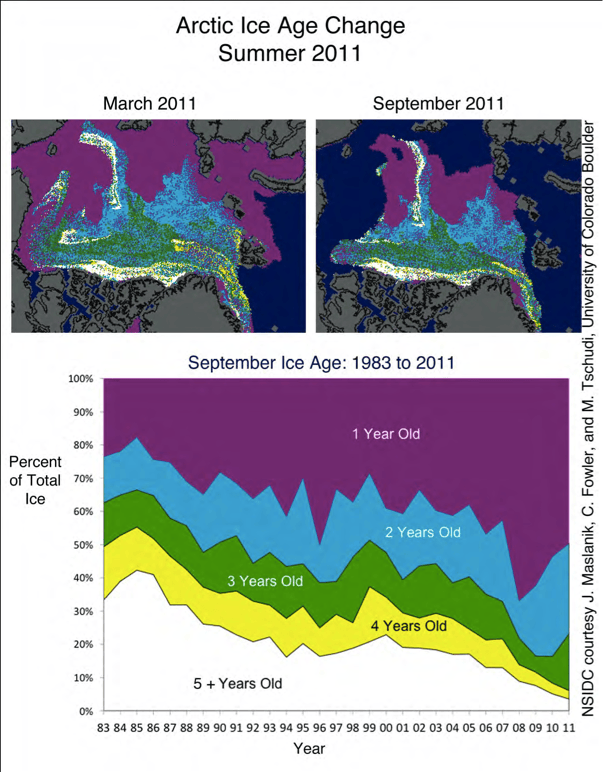
Arctic seaweeds
Baffin Island, mostly north of the Arctic Circle, is the 5th largest island in the world, with a surface of 507, 451km2. To put that into perspective, it is more than twice the size of Great Britain! The expedition to the island was based in two locations – Pond Inlet, and Cape Hatt.
Observations from a previous expedition in 2003 had measured sea surface temperature to be approximately 0-1C – only 6 years later, Küpper and his team found it had risen to 6-7C. This rise in temperature has caused a shift in species diversity – the Arctic flora range has become less “Arctic”, and more “boreal” in character. Küpper suggested the possibility of new arrivals of species from the North Atlantic and North Pacific in the High Arctic.
Küpper and his team had difficulties in interpreting the data they collected due to poor and incomplete historical baseline data of seaweed biodiversity, especially of the American Arctic. So far, there is no knowledge at all about pathogens affecting seaweeds of the American Arctic.
At present, intertidal habitats around Baffin Island resemble deserts; few organisms can survive these environmental extremes with temperatures reaching below -55C during winters.
Küpper and his team documented the species present at a range of depths by bravely embarking on a number of dives. At around 2m’s depth, in the upper sublittoral zone, in summer only, fast-growing filamentous seaweeds grow. Fucus evanescens grows only on the edges of rocks, as the top experiences erosion by sea ice in the winter.
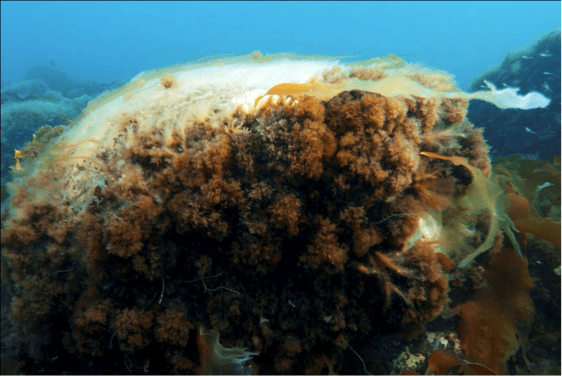
– Dramatic example of the effects of sea ice abrasion on seabed biota
The first kelps appear at 4-6m’s depth and can reach depths of up to 15m’s, creating a forest-like canopy of kelp.
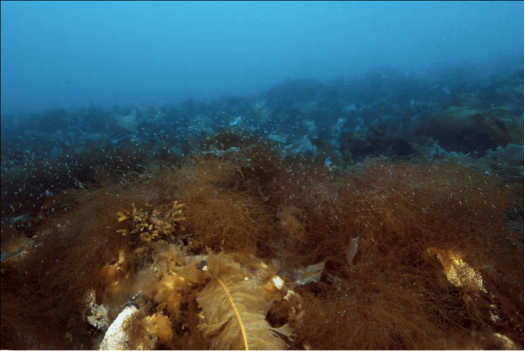
– Forest-like canopy of Desmarestia aculeate and kelps, with a shoal of krill
At approximately 12-15m’s deep, communities are dominated by coralline red algae, and kelp becomes sparse.
Approximately 70 algal strains, isolated from substratum samples were identified during the dives in the 2009 expedition, in addition to roughly 200 samples of seaweed tissues. One of the most interesting breakthroughs of the expedition was the discovery of Platysiphon and Platyarcticus. Originally thought to be two different species, DNA analysis proved them to be identical, and it was concluded they were the same species, just at different stages in their life cycle.
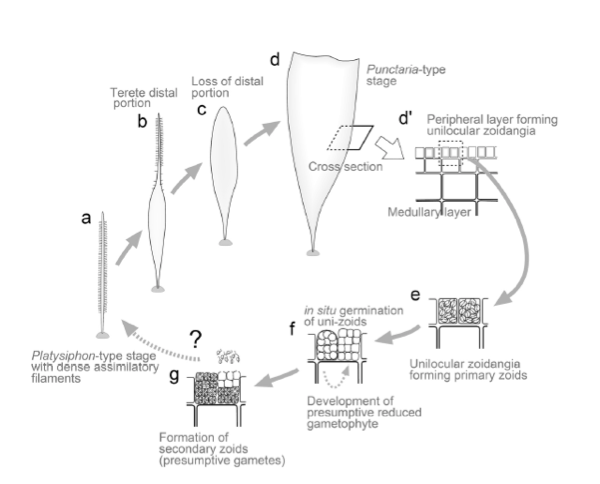
– Schematic presentation of presumptive life history of Platysiphon sp.
Julia Kleinteich, one of Küpper’s PhD students, studied polar cyanobacteria, and their potential to release toxins with increasing sea temperature. She found that a temperature shift to 8-16°C shows high cyanobacterial diversity and increased production of cyanobacterial toxins. Thus, climate change may alter cyanobacterial diversity and can result in a shift to toxin-producing species or to elevated toxin production by pre-existing species. This is significantly worrying for marine Arctic ecosystems.
Antarctic seaweeds
The diversity of seaweed species of the southwestern Antarctic Peninsula region is poorly studied. The region is affected by contemporary climate change with significant consequences such as:
- Changes in temperature and light exposure,
- Sea ice recession
- Increased iceberg scouring
- Increased inputs of glacial meltwater
All of the consequences stated above have major impacts on benthic communities leading to shifts of their geographical distribution and depth zonation.
Records of the 1973-75 expeditions by Moe and DeLaca (1976) in southwestern Antarctic Peninsula (Adelaide Island/ Marguerite Bay) were compared with recent recordings from Küpper’s in 2010-2011. Küpper his team covered 9 sites in the vicinity of Rothera Research Station and underwent 17 dives reaching a maximum depth of 35m (unreal!).
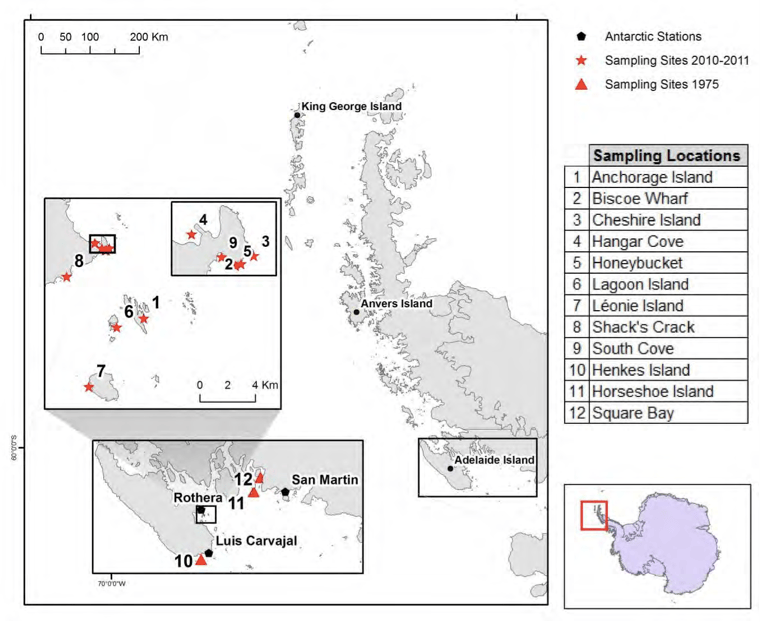
– Comparison of the 1973-75 expedition by Moe and DeLaca, and the 2010-11 expedition by Küpper
There were 18 newly recorded taxa for Adelaide Island / Marguerite Bay region in 2010-2011. Küpper three plausible explanations for this: (1) Limited range and number of surveys, (2) large variation between sites and (3) migration further south and loss of species observed in 1975 (replacement by the species found in the 2010/11 study).
The Antarctic Peninsula alongside the High Arctic, are two of the fastest warming regions on Earth. Küpper stresses the importance of more seaweed biodiversity studies in the polar-regions in the future, before the onset of major climate change impacts.
I’d like to thank Frithjof Küpper for giving such an insightful seminar, and also for kindly providing me with the brilliant photos in this blog!
 Geo takes GEOscience