
Neil Bowles, a researcher from the Department of Physics at Oxford University, gave an interesting seminar at the University of Edinburgh, where he enlightened his audience on the importance the Moon’s temperature and the possibility of trapped water-ice.
The Moon, been there done that? Why bother?
Why bother studying the Moon when it has already been done? Next year marks the 50th anniversary of the first moon landing – the biggest problem however is that we haven’t been back in a serious way (Chinese landed recently, but there hasn’t been any people going back).
Key lunar facts
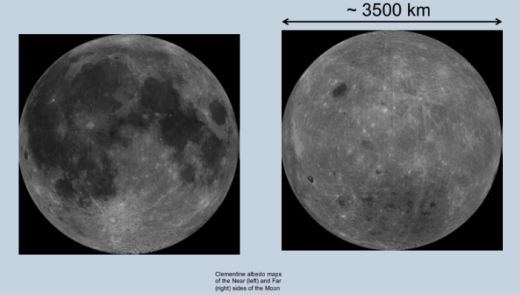
The Moon is approximately 3500km across and there is a massive difference in topography on the near and far side of the moon. There near (left) side is covered in flood basalt (seen as dark patches), whilst the far side (right) is heavily cratered. Understanding why these sides of the Moon are so vastly different holds very interesting questions.
One of the big outcomes from the Apollo mission was the first look at a detailed mineralogy and geochemistry – it became clear that the Moon formed in a very hot state and that the fracturing and mineral assemblages gave the Moon its structure that we see today.
Years later however we still don’t understand much about the formation of the Moon – a big problem with the measurements and samples from past missions is that they tend to come from a relatively narrow region on the Moon’s surface. For engineering and safety reasons, the Apollo landings all happened in a relatively narrow band near the equator, and for temperature controlled reasons they all landed in relatively flat regions. As there are no samples that have come from the far side, Bowles stressed the enormous amount left we have to learn.
Measuring the temperature of the Moon’s surface has a rather big role in helping researchers revise their understanding of what they think they know about the Moon from Apollo and where this leads in the future.
What is temperature doing in this picture and why does it matter?
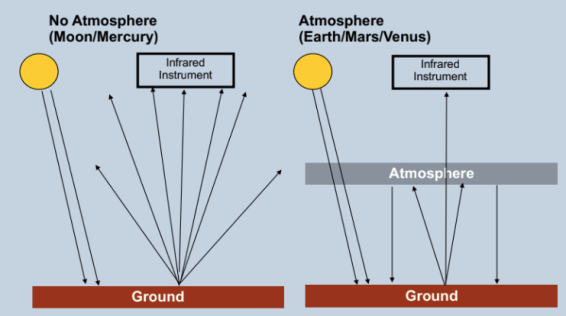
The big difference between the Moon and the Earth is that there is no atmosphere. On the earth there is an atmosphere that absorbs some of the energy from the sun and reemits this in to the ground. The Moon does not have anything like this – on the Moon you can expect to see regions that are in direct sunlight getting incredibly hot very quickly (due to the dark surface and albedo affect), and regions where the sun does not shine getting extremely cold rapidly.
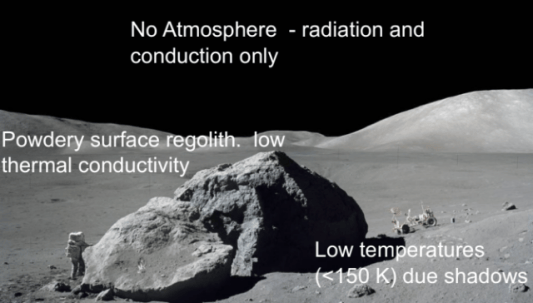
As there is no atmosphere, radiation and conduction can only occur. Where we see fine powdery surface there is very low thermal conductivity and radiation between individual grains becomes an important mechanism for transferring heat. This means there is little communication laterally across the surface of the Moon.
Where the astronaut (pictured) is standing in the sunlight the temperature was probably ~60C – if he had stepped into the shadow region, the temperature would have plummeted to <150K. This means that anywhere there are shadows there are very low temperatures. This rock (pictured), for example, will store heat very effectively and thus, the way that the surface responds to heat change can be used to determine the rockiness/ powdery-ness of the surface.
What can maximum surface temperatures tell us?
If we understand the maximum surface temperature of the moon, we can determine when things freeze out and when we can expect things to condense. Researchers are particularly interested in how this might affect water.
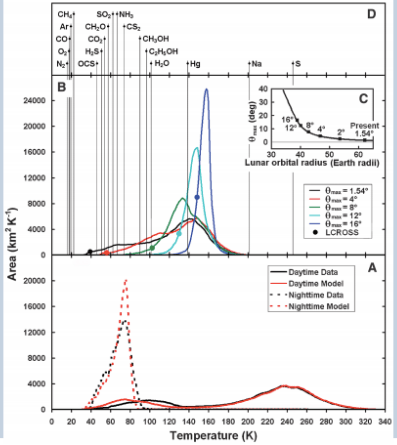
At roughly 120K, water is essentially solid and it becomes fixed in place for billions of years – the vapour pressure and the evaporation rate is so low that if you can deposit water and it finds its way into a cold trap, where the temperature never gets above 120K, there is the possibility of trapping water-ice. By measuring the sensitivity of the moon we can look at places where it is thermodynamically possible to capture and trap water-ice.
Why we care (1): water ice and potential resources
If there is water-ice trapped in the shadowed regions, this is a potentially very valuable resource. As well as providing water and oxygen for a future human base, you could also use it to produce rocket fuel.
Where might water ice be stable on the Moon?
With a 6.6 degree axial tilt, the Moon’s topography dominates the temperature measured at the poles. You can find regions where shadows are thrown across craters that are incredibly deep, and because of the low axial tilt, the sun literally never shines in these regions (pictured below).
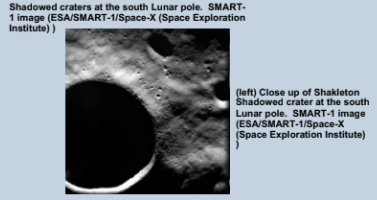
This is not a new idea and was first proposed by Arthur C. Clarke in 1954. In the late 1990’s the Lunar Prospector was launched and appeared to show increases in hydrogen concentrations at the poles. The results remain controversial – in 2007 the Japanese spacecraft “Kaguya” was launched, which imaged inside a few of the “shadowed” craters and found no evidence for exposed water-ice – they did however find very low temperatures.
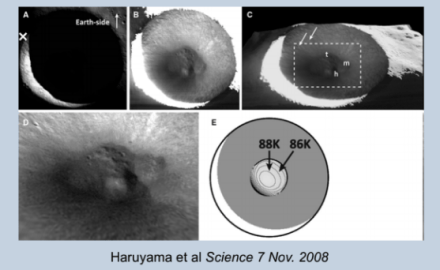
Clearly, much more data is required for this theory to be determined including; temperatures near the lunar pole regions; possible active detection methods for water-ice; and more robust thermal models that can predict surface temperatures and possible sub-surface trapping.
Why we care (2):
Variation of surface temperature with time can give important information on surface roughness, and the presence of boulders vs. fine regolith. It can also give us an idea of surface environments and the possibility of trapping volatiles.
In order to further our understanding of surface temperature, there is a strong requirement for a thermal mapping instrument and global temperature maps. None of the missions in the past had a thermal camera sensitive to < 120K temperatures.
Enter LRO
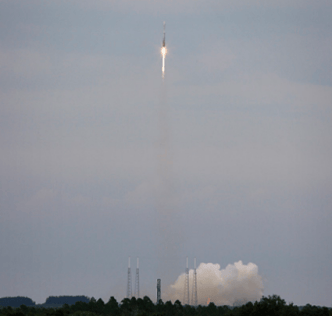
The Lunar Reconnaissance Orbiter (LRO) launched in June 2009 had the lowest mapping orbit of any of the past missions and had a very high-resolution camera (<1m resolution). The LRO provided detailed mapping to identify safe landing sites and potential resources and was comprised of six instruments and one tech demo: (1) Cosmic Ray Telescope for the Effects of Radiation (CRaTER), (2) Diviner Lunar Radiometer Experiment (DLRE) – instrument Neil worked on, (3) Lyman Alpha Mapping Project (LAMP), (4) Lunar Exploration Neutron Detector (LEND), (5) Lunar Orbiter Laser Altimeter (LOLA), (6) Lunar Reconnaissance Orbiter Camera (LROC) and (7) Miniature Radio Frequency Technology Demonstration (Mini-RF)
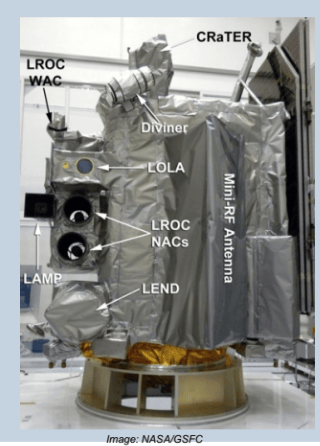
LRO Diviner overview
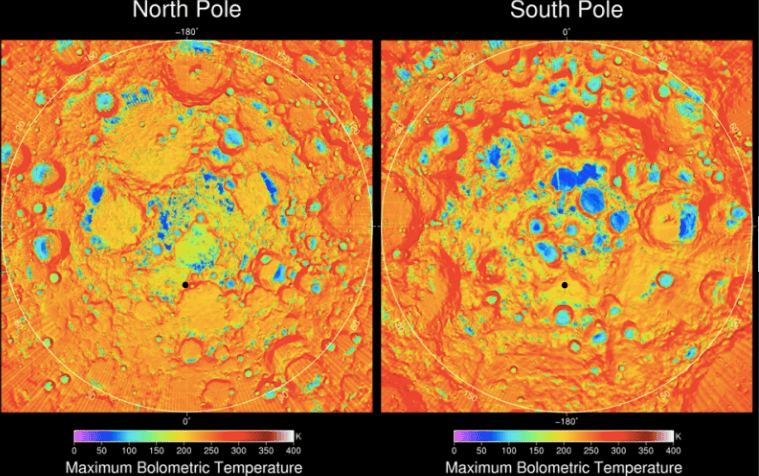
The three main aims of the LRO were to; characterise the Moon’s surface thermal environments (daytime, nighttime, and polar); to map properties of the lunar surface (including bulk thermal properties, rock abundance, and composition); and most importantly – to characterise polar cold traps.
LRO Diviner observed maximum temperatures
In the North Pole there are clearly some spots where it is extremely cold (blue colour is temperature below 100K) – though the South Pole is much more promising.
Conclusion
Thermal data can provide important information on the location of possible permanent cold traps on the lunar surface and near sub-surface. Trapped water may be a useable resource for future exploration and the polar cold traps could also provide a valuable source of samples, exploring the process of volatile transport in the Solar System. Knowing the temperature of the moon may be the key to exploring the Solar System.
I’d like to thank Neil once again for presenting such a captivating and fascinating seminar. I was over the moon (pardon the pun!) after attending.
 Geo takes GEOscience