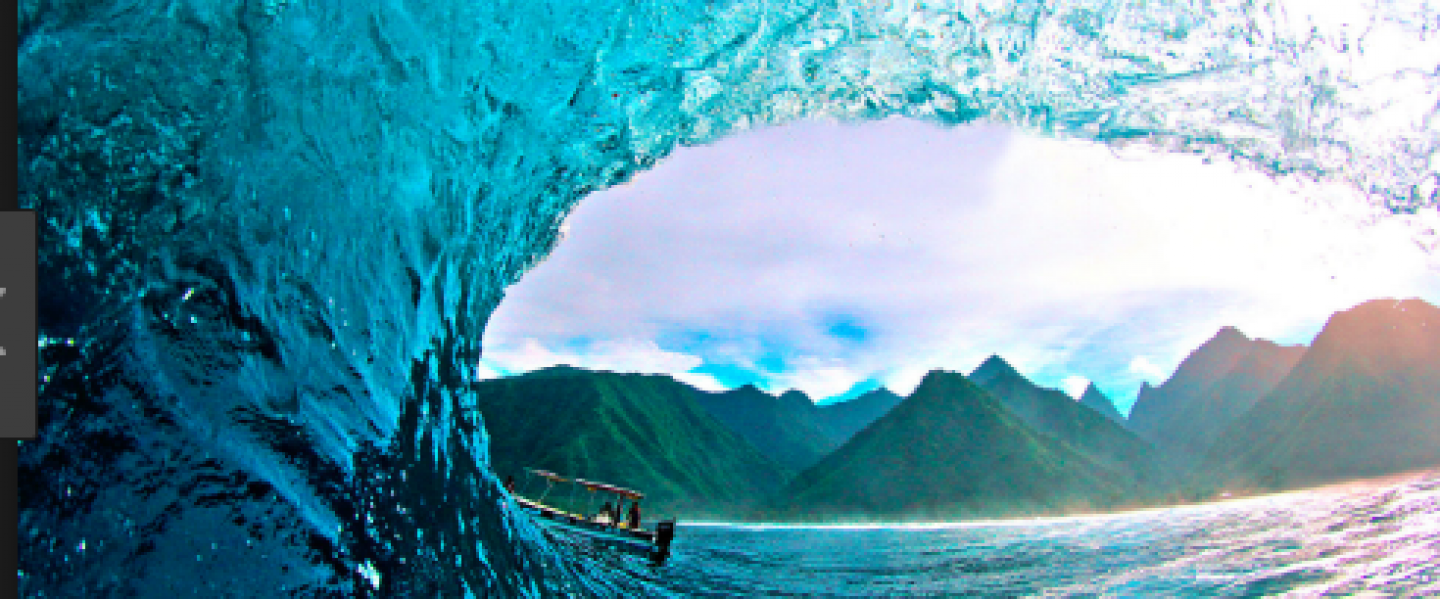

Greenland’s fast flowing tidewater glaciers contribute significantly to sea level rise, yet little is known about the conditions within and beneath them.
Last week I attended a seminar by Bryn Hubbard, from Aberystwyth University, who discussed the fieldwork he embarked on whilst studying the Store Glacier in Greenland. The seminar primarily focused on the challenges that are often encountered when working in such environments and the methods used to successfully gather information from glaciers.
Store Glacier, the third fastest outlet glacier in West Greenland, is one of the largest, draining a catchment area of ∼34, 000 km2. The glacier discharges into Uummannaq Bay, where its calving front is heavily crevassed with unstable seracs, characteristic of fast flow. In contrast to other Greenlandic outlet glaciers, which have thinned and retreated over the last two decades, the terminus of Store Glacier has remained in a similar position for the last 70 years.
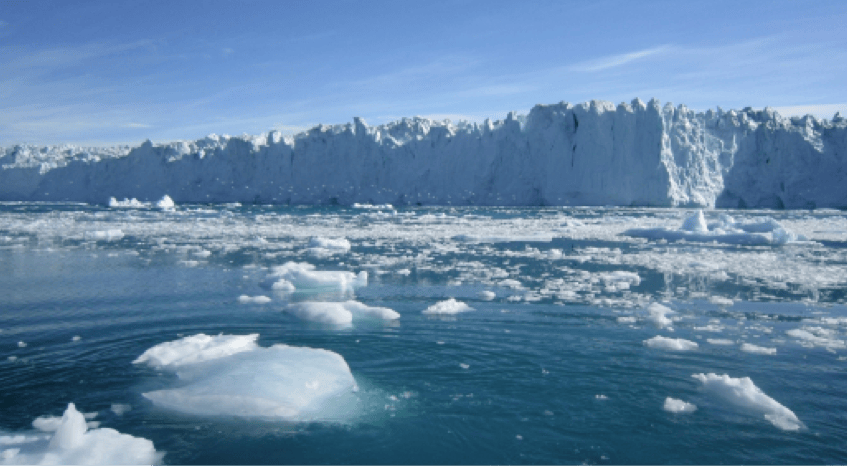
Store Glacier, Greenland
The initial challenge that research teams continuously face is funding. Bryn began the seminar by stressing the logistical constraints, which makes fieldwork in Greenland so difficult. Funding must be applied for, which requires thorough planning and preparation. Whether or not research is granted funding often comes down to luck and when, where or how much money will be received can vary. Fortunately, Bryn and his team were lucky enough to be granted funding for their research, and the preparation that followed involved transporting tonnes of equipment across the world.
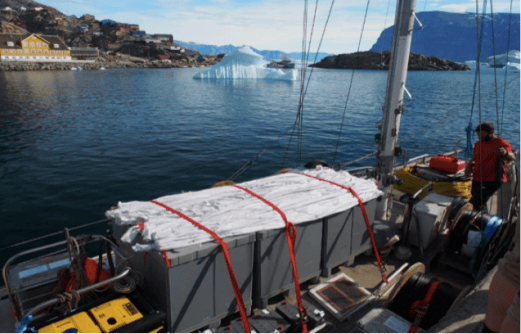
The teams equipment being transported
After arriving at the airport in Greenland a helicopter transported their equipment onto the glacier, which was then dragged by a snowmobile to the chosen campsite. Bryn emphasised how expensive helicopters and snowmobiles can be to hire, and so the shortest route possible is always chosen.
Ice sampling
Bryn and his team set up there camp 30km from the glaciers terminus. A glacier can be sampled in many ways, most commonly via direct access. This involves glaciologists accessing the glacier themselves, and finding naturally occurring ice caves where they examine inner glacial dynamics. Glaciologists may also decide to dig caves themselves if there are not naturally occurring ones available.
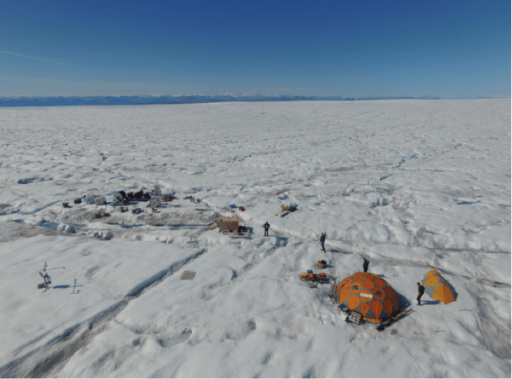
The teams research camp, 30km upstream from the glaciers terminus
Ice coring
Ice coring is a common and efficient method, which allows the sampling of individual layers in a glacier. A glacier is drilled and a core is obtained, which is then examined. The components of the ice core; layer colour, thickness and composition are studied and can be used to determine the ‘health’ of a glacier, as well as its climatic history. The problem with ice coring is that it is extremely expensive and can be rather time consuming.
Geophysical techniques
Geophysical surveying remotely samples the subsurface of a glacier. The most common techniques involve radars (shallow) and seismic reflections/refractions (deeper). The problem with these techniques is that they only provide proxy data.
Hot water drilling
Hot water drilling, a process considered easier than ice coring, was the method used by Bryn and his team. The process involves lowering a hose into the ice (2m per minute), which then fires hot (70oC) water at high pressures (150bar). The boreholes produced (20-30cm in diameter) are drilled to the bed of the glacier with sensors that measure ice temperature and deformation, and subglacial water properties. The most common sensors used are thermometers and tiltmeters (to calculate sliding component). One of the problems often faced with hot water drilling is the snapping of cables. Optical televiewing (OPTV) is an alternative, whereby a tiny camera is lowered into the hole, producing high-resolution imagery.
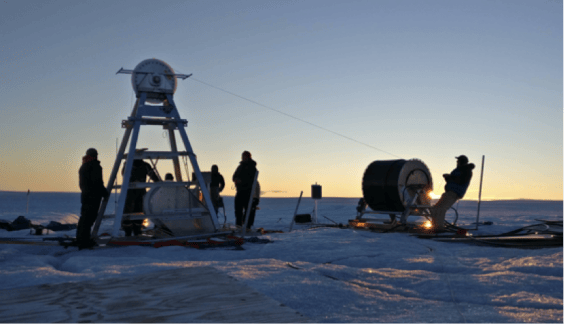
Bryn and his team drilling the boreholes
The data collected by Bryn and his team revealed that the fast flow of Store Glacier is caused by motion at the ice bed interface, driven by highly pressurised subglacial water and basal sediments.
Extending our knowledge of Greenland’s marine-terminating outlet glaciers is critical to furthering our understanding of the mechanics of their fast flow and their behaviour in numerical ice sheet models.
Thank you once again to Bryn for presenting such an enticing seminar and for allowing me to use some of his amazing photographs!
 Geo takes GEOscience