
Chris MacLeod, from the University of Cardiff, recently gave a ground-breaking seminar surrounding his work on a new perspective of seafloor spreading.
Seafloor spreading is a process that occurs at mid-ocean ridges, where new oceanic crust is formed through volcanic activity.
The theory was first proposed in 1960 by an American geophysicist, Harry H. Hess. He suggested that molten material (basalt) wells up from the Earth’s mantle along mid-ocean-ridges, and as the magma cools, it is pushed away from the flanks of the ridges. Thus, older rocks will be found farther away from the spreading zone while younger rocks will be found nearer to the spreading zone.
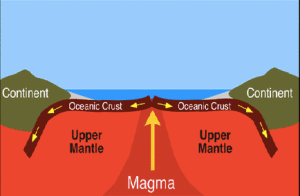
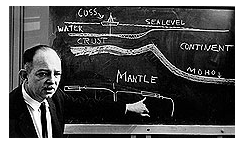
It was assumed, from seismic surveys, that the crust had a uniformly layered structure comprised of; pelagic sediments overlying pillow lavas; sheeted dykes; gabbro; seismic Moho (a discontinuity observed from seismic wave speed profiles); layered gabbro; petrological Moho; and residual mantle peridotite.
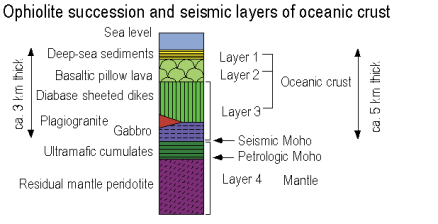
This simple ‘layer-cake’ model for seafloor spreading was widely accepted for a long time; however, it has been thrown into serious question by recent and on-going academic research.
Problems with the layer-cake model
At slower spreading ridges, serpentinite (serpentinite = peridotite + water) is commonly observed, disproving the standard layer-cake model. So why do we see rocks from the mantle on the seafloor?
One hypothesis to explain the observed displacement is faulting. During the 2001 Atlantic JR63 expedition cruise flat-topped curved massifs of serpentinite, which exhibited striations, were discovered near spreading ridges. These striations, now referred to as oceanic core complexes (OCC), are low-angle detachment faults, which act in pulling the plates apart. Drilling of these surfaces has shown that fault rock is present on the surface and is comprised of weak Talc schist, allowing it to slip continuously. OCC’s are considered to be an intrinsic part of the seafloor spreading process in regions of slow-spreading mid-ocean ridges.
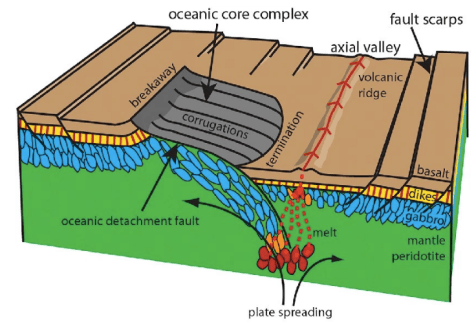
MacLeod’s research offers a brand new perspective of how sea floor spreading works. However, he also stressed how much more we have to learn. Drilling expeditions near the Indian ridge found surface rocks with completely different features. Whether these were produced by an alternative spreading mechanism than the one observed at the Mid-Atlantic Ridge remains uncertain.
Thanks again to Chris for presenting such a thought-provoking seminar!
 Geo takes GEOscience