

“A water crisis in Scotland? But it rains all the time?”
Dr. McGrane gave an interesting seminar where he discussed the links between a country’s water resources and it’s economy.
The Scottish Economy
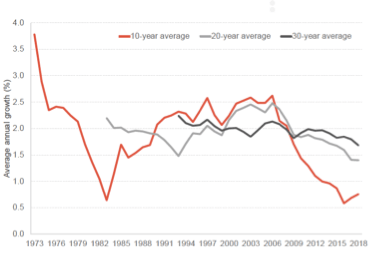
Previous years have shown economic growth in Scotland to be extremely slow. Future uncertainty beckons as a result of things like Brexit, however many of the challenges that we face are reflect an underlying weakness in productivity and our ageing population.
Scotland’s Water Resources
Scotland is typically regarded as a wet country, with plentiful freshwater resources available to sustain the demands imposed by society, the economy and our ecosystems. However, recent years have shown an increase in summer temperatures across Scotland, along with a significant decrease in rainfall.
Water and the Economy
Direct abstraction from water bodies or rainfall support a number of key sectors in the Scottish economy, including whisky, agriculture, soft drinks, and craft beer production. Unlike public water supply (Scottish Water), water supply is “private” in the non-domestic customer market (whole sale provision to 23 suppliers provide water to c.130,000 business customers). As a result, mapping water use can be a substantial challenge from a data perspective as there is no central, publicly available resource that illustrates water use in Scotland.
Despite the current state of ”plenty”, climate change and population growth will increase pressure on Scotland’s water resources. UKCP18 projections highlight wetter winters, with less precipitation occurring as snowfall. Increasingly hot and dry summers are also expected, inferring that seasonal stresses may prevail.
Economic Implications
Predominate water users are in the refined petroleum and pharmaceutical manufacturing sectors, accounting for approximately 16% of all non-domestic consumption. Accommodation and food services, combined with food, beverage and tobacco manufacturing consume 10% of Scotland’s water supply. The whisky industry is Scotland’s largest product exporting sector (in terms of GVA), exporting 1.2billion bottles per year. The industry supports roughly 70k jobs across the UK with nearly 10% of this being in rural areas. Impacts of climate change and water go beyond the immediate regional consequences to water in Scotland – reducing barley yields, and impacting forests.
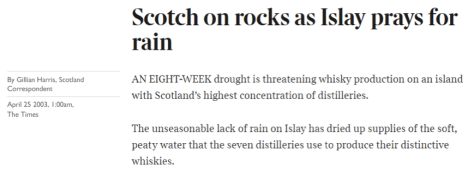
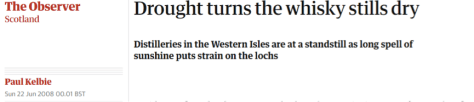
Meanwhile, both agriculture and electricity and gas supply waste 8% and 7% respectively. Agricultural direct impacts may impact food security or food supply reliability for industries in manufacturing or services (e.g. hotels).
Concurrently, some cities are experiencing higher visitor numbers, in turn increasing water demand across several sectors of the Scottish economy. For example, Edinburgh enjoys an influx of tourists during the summer, when rainfall is the lowest. What is particularly interesting is how changes in the weather over a long period of time may impact Scotland’s economy.
Scottish Water identify the following six elements as important drivers for change in the water landscape in Scotland:
- Climate change
- Demographic change
- Legislation changes
- Resource availability
- Political, Economic and regulatory environment changes
- Scientific and technological advances
It is crucial that we better our understanding of the links between environment, including water use and the economy, particularly as extreme climatic events such as the recent winter snowfall and subsequently dry summer period become more frequent. To thrive in a future Scottish climate, all parts of the economy will need to adapt accordingly to militate against resource depletion or reduced productivity.
Further Reading
Climate change is an important issue that demands the country combating it together. There are lots of ways in which we can all reduce our climatic impact – I’ve attached some links below that suggest easy ways to incorporate these changes in our daily lives.
- https://davidsuzuki.org/what-you-can-do/top-10-ways-can-stop-climate-change/
- https://www.nbcnews.com/better/science/6-ways-ordinary-people-can-prevent-climate-change-according-researchers-ncna926311
- McGrane, Scott J.and Allan, Grant J. and Roy, Graeme (2018) Water as an economic resource and the impacts of climate change on the hydrosphere, regional economies and Scotland. Fraser of Allander Economic Commentary, 42 (4). pp. 53-74. ISSN 2046-537
 Geo takes GEOscience