
I don’t know about you guys, but at school I was taught there were 7 continents:
- North America
- South America
- Africa
- Asia
- Europe
- Australia
- Antarctica
However, according to new research there may be one more that we’ve been neglecting. A study published in 2017 by the Geological Society of America affirms that New Zealand may be the tip of a continent, which scientists have termed “Zealandia”, also known as the “Earth’s hidden continent”. The paper appeared to shock the world, reaching over 16,000 newsagents worldwide.
So how is it possible that an entirely new continent could even be proposed? Hamish Campbell, one of they key researchers who contributed to this paper, gave an enthusiastic seminar explaining this. He began his seminar by describing the difficulty he and his team faced when finding a scientific definition of a continent. The Glossary of Geology describes a continent as being “one of the Earth’s major land masses” consisting of the following characteristics:
- A high elevation relative to regions floored by oceanic crust
- A diverse range of siliceous igneous, metamorphic and sedimentary rocks
- A thicker crust and lower seismic velocity structure compared to oceanic crust regions
- Well-defined limits around a large enough area, which is considered a continent
Campbell and his colleagues illustrate in their paper how Zealandia has all of these characteristics and should therefor be classified as a continent. What remains unclear is how large an area must be for it to be considered as a continent. Thus, they provided their own answer: ‘A continent, is an area of continental crust that exceeds an area of 1 million km2”.
Research in relation to elevation and geology of the region further supports the idea of Zealandia.
Elevation
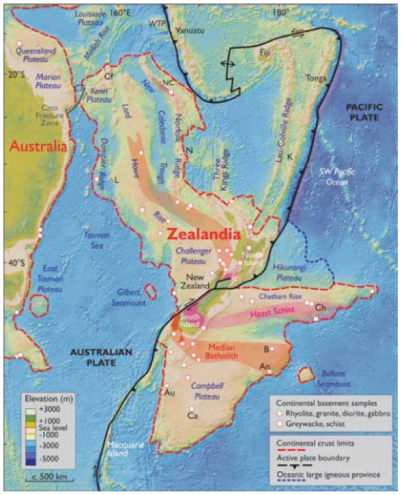
Continents and their continental shelves vary in height but are always elevated relative to oceanic crust. The existence of bathymetric features north and south of New Zealand has been known for years. A colour ramp on a satellite gravity-derived bathymetry map, produced by Stagpoole (2002), illustrates the extent of continental crust (Fig. 2). The approximate edge of Zealandia can be placed where the oceanic abyssal plains meet the base of the continental slope, at water depths between 2500-4000m below sea level. The results show that Zealandia has a modal elevation of ~1100 m, and although it may sound silly, given how tiny New Zealand appears on a map, research has shown that nearly 94% of Zealandia is submerged below current sea level.
Geology
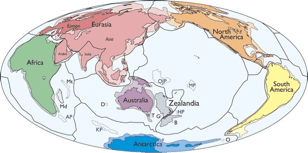
The relatively high elevation of Zealandia is not enough to prove its continental status. Continental crusts typically have diverse assemblages of igneous, metamorphic, and sedimentary rocks, such as granite, limestone, schist, and gneiss, arranged in orogenic belts and sedimentary basins. Palaeozoic and Mesozoic greywacke, schist, granite, and other siliceous continental rocks are evident provided by the Chatham Islands outcrops, drill cores and seabed dredge samples within the region of Zealandia (Fig. 2). Traditionally, continents have been subdivided into cratons, Phanerozoic orogenic belts, and broad extensional provinces. Precambrian cratons have been identified in all of the continents apart from Zealandia, however their existence has been postulated on the basis of Rodinian to Gondwanan age detrital zircon ratios (Fig. 3 shows Zealandia as part of the former Gondwana supercontinent.
Conclusion – what makes Zealandia a continent?
Based on various lines of geological and geophysical evidence, particularly those accumulated in the last two decades, Campbell and his colleagues have concluded that Zealandia is a coherent 4.9 Mkm2 continent. A combination of characteristics led them to this conclusion…
- The size of Zealandia (4.9Mkm²) makes it large enough to be a continent.
- The crust (20-35km) is thicker than oceanic crust but still thinner than normal continental crust.
- It is surrounded by oceanic crust
- The geology found at Zealandia is largely continental and evidence suggests Zealandia was once a part of Gondwana.
For anybody with an interest in geography, this is an exciting development. The designation of Zealandia as a continent is crucial to scientists studying the composition and breakup of continental crust. By investigating the elevation and geology of New Zealand and the Chatham Islands it is clear that Zealandia is a continent. The work carried out by Campbell and his team highlight the importance of continuous research that is necessary to further our understanding of geological processes.
Further Research
I hope you found this blog interesting, I certainly was shocked to hear of a new continent! If you’d like to read more about Zealandia then have a look at the links below!
- Mortimer, N., Campbell, H., Tulloch, A., King, P., Stagpoole, V., Wood, R., Rattenbury, M., Sutherland, R., Adams, C., Collot, J. and Seton, M. (2017). Zealandia: Earth’s Hidden Continent. GSA Today, pp.27-35. http://www.geosociety.org/gsatoday/archive/27/3/article/GSATG321A.1.htm
- https://interestingengineering.com/everything-you-need-to-know-about-zealandia-earths-hidden-continent
 Geo takes GEOscience