
Have you ever wondered what’s beneath one of the largest ice caps in the Canadian Arctic?
Last week I attended a seminar by Martin Sharp where he presented evidence for the existence of a hypersaline subglacial lake beneath the Devon Ice Cap (DIC), one of the largest ice caps in the Canadian Arctic (Fig. 1).
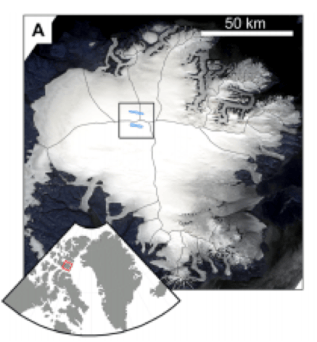
In order to determine what features were beneath the DIC, Sharp took radio-echo sounding measurements, a common technique used when identifying sub-glacial lakes. The results revealed there was not one, but TWO sub-glacial lakes beneath the ice cap! Analysis of regional geological maps further supported the presence of these lakes, illustrating geological troughs at the location of the lakes, which would allow for water to accumulate.
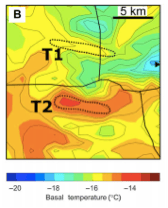
Basal temperature
Using a steady-state advection-diffusion model, the team calculated basal temperatures between −18.5° and −10.5° (Fig. 2). These modelled temperatures are clearly well below the pressure-melting point for fresh water (−0.5°C); thus, the team concluded that the subglacial lakes beneath DIC must contain hypersaline water with a remarkably lower freezing point.
Geology
Geological mapping shows outcrops of Cambrian-Ordovician sediments, including an evaporite unit, to the west of DIC (Fig. 3). Furthermore, drill cores from Bathurst Island have show that the bottom of the Bay Fiord Formation contains a bedded salt sequence, consisting almost entirely of halite. Sharp and his colleagues produced a geological model that revealed the salt-bearing Bay Fiord Formation outcrops near the DIC summit area, where it encloses the subglacial lake. The presence of the salt-bearing unit underlying the DIC area supports the existence of a substantial hypersaline subglacial lake complex, where the halite contained in the Bay Fiord Formation provides the main source of salinity.
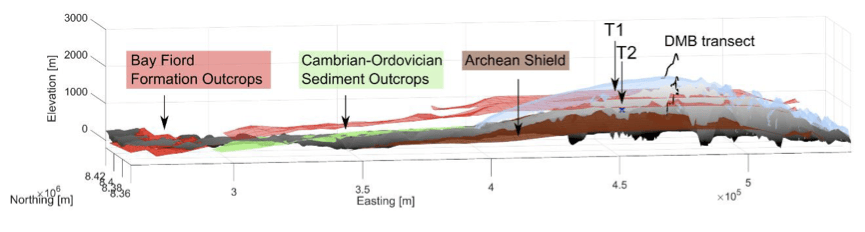
The observation of radar signatures indicative of subglacial water, basal ice temperatures well below the pressure-melting point, and the outcrop of a bedded salt sequence beneath the ice all provide convincing evidence for the existence of a hypersaline subglacial lake beneath DIC.
How did these lakes form?
The origins of the hypersaline subglacial lakes, and the processes driving their formation remain unclear. Martin discussed two differing ideas as to how such lakes came to exist:
- Ordovician anhydrite (salt evaporate) is abundant near the site. The anhydrite could potentially dissolute, making the water more saline.
- Repeated freezing and melting of the lakes over time has led to the water becoming more concentrated and saline.
A subglacial fluid with temperature and salinity values similar to the hypersaline lake system beneath DIC is the brine beneath Taylor Glacier, Antarctica. Although this brine body is not an isolated subglacial lake, it is attached to a salt-rich groundwater system. Interestingly, active microbial communities have been recorded in the water flowing out from Taylor Glacier, indicating that life is possible in such environments. This raises important questions regarding the DIC subglacial lakes and whether they too have the potential to support microbial life.
Conclusion
Understanding the processes which lead to the formation of hypersaline lakes and whether they can support life could help further our understanding of similar sites on Mars, where the presence of liquid water beneath ice has been inferred. With the current threat of global warming, Sharp’s research proves important in order to determine future melt rates.
Further reading
I hope you guys found this blog ***COOL*** (get it, cool… cold… ice…). I for one was surprised to hear there were lakes beneath the ice cap! If you’d like to read more about the DIC and the formation of subglacial lakes, have a look at the links below…
- http://glacierhub.org/2018/05/15/unprecedented-subglacial-lakes-discovered-in-canadian-arctic/
- Koerner, R.M., 1966. Accumulation on the Devon Island ice cap, northwest territories, Canada. Journal of Glaciology, 6(45), pp.383-392.
- Koerner, R.M., 1977. Devon Island ice cap: core stratigraphy and paleoclimate. Science, 196(4285), pp.15-18.
- Rutishauser, A., Blankenship, D., Sharp, M., Skidmore, M., Greenbaum, J., Grima, C., Schroeder, D., Dowdeswell, J. and Young, D. (2018). Discovery of a hypersaline subglacial lake complex beneath Devon Ice Cap, Canadian Arctic. Science Advances, 4(4), pp.1-6.
 Geo takes GEOscience